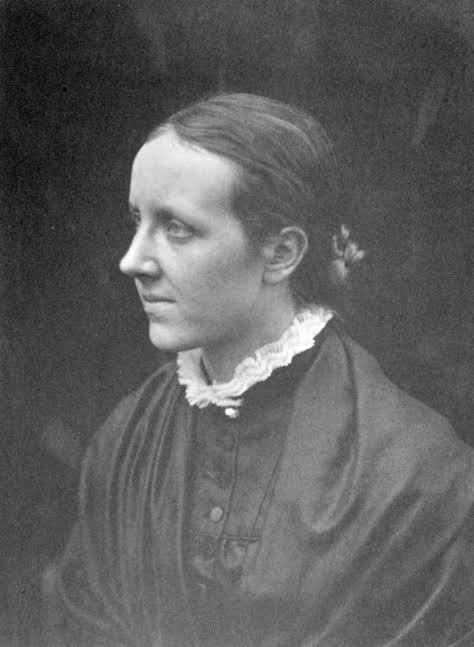
 Ida, Lady Darwin (born Emma Cecilia Farrer, November 7, 1854 – July 5, 1946) was a prominent British social reformer, mental health advocate, and prominent member of the
Cambridge academic community.
Ida, Lady Darwin (born Emma Cecilia Farrer, November 7, 1854 – July 5, 1946) was a prominent British social reformer, mental health advocate, and prominent member of the
Cambridge academic community.Queer Places:
Ascension Parish Burial Ground, Cambridge, City of Cambridge, Cambridgeshire, England
Ida, Lady Darwin (born Emma Cecilia Farrer, November 7, 1854 – July 5, 1946) was a prominent British social reformer, mental health advocate, and prominent member of the
Cambridge academic community.
Born to Thomas Farrer (Permanent Secretary to the Board of Trade) and Frances Erskine, she adopted the name "Ida" from Hans Christian Andersen’s fairy tale Little Ida's Flowers. On January 3, 1880, she married Sir Horace Darwin, a civil engineer and the youngest son of the famous naturalist Charles Darwin and Emma Darwin. The couple settled in Cambridge at "The Orchards," a large mansion on Huntingdon Road, where Ida used her social standing and household staff leisure to direct extensive philanthropic and civic projects.
Ida Darwin was a pioneer in social welfare. In 1883, she co-founded the Cambridge Association for the Care of Girls to assist working-class young women. Her work with disadvantaged youths transitioned into a lifelong dedication to mental health reform. Alongside Florence Ada Keynes, she campaigned for better local care structures, eventually helping establish the Central Association for the Care of the Mentally Defective (later renamed the Central Association for Mental Welfare) in 1913, serving as its vice-president for decades. She passed away on July 5, 1946, at the age of 91.
Active between 1890 and 1914, the Ladies Dining Society was an elite, private discussion group founded by twelve influential women connected to the University of Cambridge (including academics' wives and Newnham College figures).
The group met fortnightly to debate pressing intellectual, political, and social issues—such as women's suffrage, higher education, and professional equity—at a time when women were largely locked out of formal university governance.
Alongside Ida Darwin, the society included prominent intellectual figures such as Ellen Darwin, Maud Darwin, Caroline Jebb, Mary Paley Marshall, Fanny Prothero, Eleanor Sidgwick, Margaret Verrall, Eliza von Hügel, Mary Ward, Louise Creighton, and Kathleen Lyttelton. It served as an intellectual powerhouse for early feminist and reformist thought in Cambridge.
Direct historical records concerning Ida Darwin’s personal sexuality or explicit links to modern definitions of LGBTQ+ identity are absent; her life followed the conventional framework of a late-Victorian upper-class marriage. However, her broader circles and family legacy intersect with LGBTQ+ history in a few notable ways:
The extended intellectual networks that Ida and Horace Darwin inhabited in Cambridge and London included figures who pushed the boundaries of Victorian gender roles and sexual mores. The era's shifting perspectives on sexology—explored early on by European researchers like Magnus Hirschfeld looking closely at evolutionary biology—gradually re-evaluated human sexual variation.
Modern LGBTQ+ historical and scientific critique frequently looks back at the Darwin family legacy. Contemporary evolutionary biologists and historians (such as Joan Roughgarden) have extensively re-analyzed Charles Darwin's theories of sexual selection to untangle heteronormative biases, exploring instead the deep historical roots of gender diversity and non-reproductive sexual behaviors in nature and human societies.
References:
Support this project
This website is a passion project researched, developed, and funded entirely by me. If you find the content valuable and would like to help support the ongoing research and hosting costs, any contribution is deeply appreciated.
Thank you for keeping this independent resource alive!
My books on Amazon: Elisa Rolle's books